Permanent or bioresorbable tricopigmentation
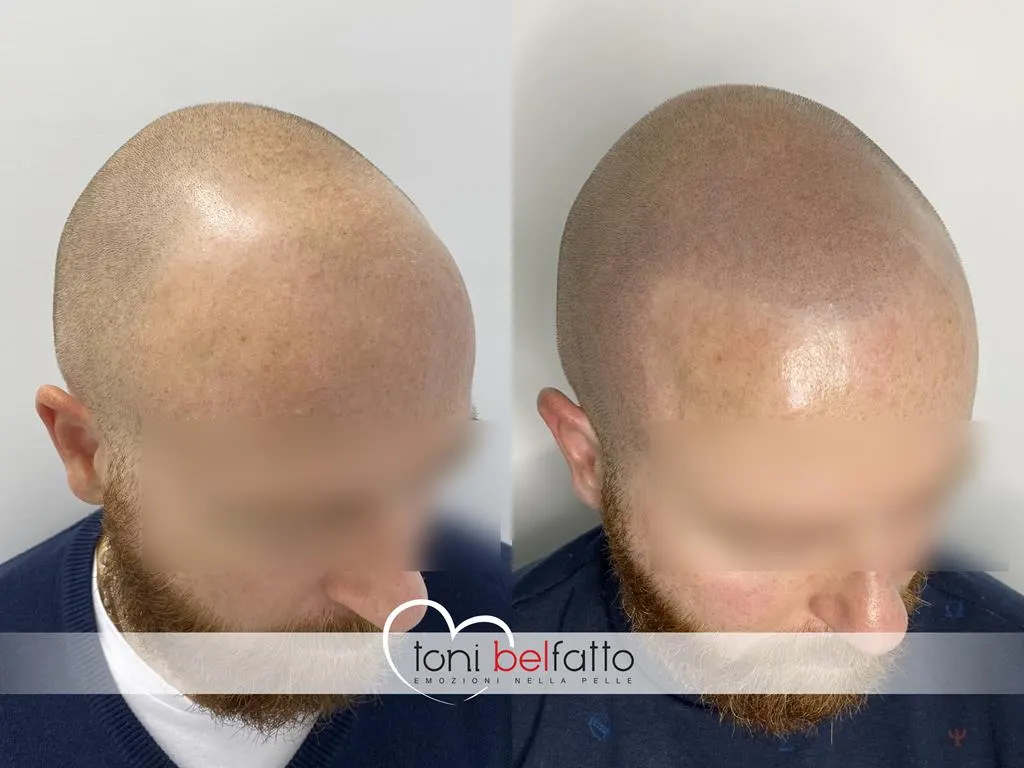
Tricopigmentation is a specialisation that emerged in the late 1990s. In 2009 Toni Belfatto registered the Tricopigmentazione and Bounce trademarks with Ennio Orsini. Its aim is to address the visible effects of baldness, scarring and any imperfection that in some way involves body hair or scalp hair.
During tricopigmentation, mineral pigments are placed in the dermis. These pigments must meet safety standards that are now governed by ResAP, a European resolution regulating their production and subsequent use.
There are indelible pigments (in this case we speak of permanent tricopigmentation), which are definitive, and bioresorbable pigments, which remain in the skin for a limited time. How long the latter last varies with the client's age, the application technique and the individual healing response; if we had to give a range, we could safely say 6 to 24 months.
After this period, the immune system, mainly the macrophages, begins the process of phagocytosis, eliminating the pigment molecules through the lymphatic system, sweat and urine.
Semi-permanent tricopigmentation
A limited duration is often seen as a drawback or something negative, when in fact it is exactly the opposite, for three fundamental reasons.
- The first concerns colour: any pigment exposed to sunlight and artificial light changes as a result of oxidation. A black could turn green/blue after 3 years, as happens with artistic tattoos.
- The second is structural: every pigment molecule placed in the dermis changes its structure over the years, causing the dot or stroke to thicken and turning it into an unsightly mega dot that no longer resembles, in its thickness, a shaved hair, for example.
- The third reason is ageing: a colour chosen at 25 will be completely different from the one needed at 45, and then at 65. The risk is one day having a head of white hair contrasted by a green/blue patch.
Permanent or semi-permanent tricopigmentation?
The tricopigmentation artist should be thought of like a hairdresser, whom we visit every month, and women even more than once a month, for a cut or a colour. Why would we never dream of asking for a cut or a colour that lasts a lifetime? Because visiting the hairdresser to renew an ideal of beauty has become part of everyday life.
Exactly: you go to the hairdresser to have your hair cut, and to the tricopigmentation artist to have it “put back”.
As with any evolving field, especially once a phenomenon becomes a business in its own right, several websites and trade magazines unfortunately try to convince clients of an intermediate tricopigmentation lasting around 5 to 10 years, between the bioresorbable and the definitive kind, which is at odds with what the law provides on the production and use of pigments.
The expert's advice is to be wary, or to ask for a written guarantee that what is promised will actually hold over time.